Opening keynote, the 2027 CIO Agenda, IT 2030 democratization and the agentic banking session. Key ideas in our words; figures are Gartner's.
The winners are not the companies using AI the most. They are the ones whose AI value compounds faster than their AI risk.
1 in 5AI use cases deliver a positive return — unchanged from last year
86%of CIOs see AI risk growing faster than AI value
71% vs 21%will deploy AI agents by 2027 vs. have agent governance today
50%+ vs 16%productivity promised by vendors vs. median actually realized
78%of banking CIOs will have AI agents deployed by 2027
2–3×rise in AI run costs in 18 months, while build costs halve
Keynote — value vs. risk
Value and risk both compound. Each has momentum and drag
Good drag (governance, evals, controls) protects; bad drag (tech debt, platform sprawl) slows value
Compound value, not volume: scale what works, stop the rest with clear quit rules
Use agents where you need autonomy, not just automation; measure value per token
Five layers to govern: accountability, technology (agent harness, AI gateway), economics, intelligence (context is the last moat), people (AI artisans)
Keynote · CIO resource guide
Risks
Harm grows with autonomy: GenAI → agentic → physical AI moves toward irreversible harm
Shadow AI (unapproved use) and Dark AI (harm, intended or not) — treat like crime prevention, not incident response
Accountability blurs ("AI did it"): evidence trails, kill switches, a damage-control team
AI inflation during a trust recession; many AI costs never show on the bill
Postquantum crypto: cost of moving doubles each year of delay after 2026
Keynote · 2027 CIO Agenda
Adoption
IT budgets flat after inflation, but agentic AI spend up about 28%
Only 1 in 5 CIOs say IT staff is AI-ready; only 11% are "Vanguards"
Vanguards redesign roles, plan AI economics with the CFO and stop low-value pilots
Business teams will build most new agents — managed democratization needs sandboxes, templates, registries and guardrails
Regulated fintech example: agents watch business-built code for compliance and help fix it
2027 CIO Agenda · IT 2030 democratization
Banking
Competition moves from selling products to owning trusted orchestration of the customer's financial outcomes
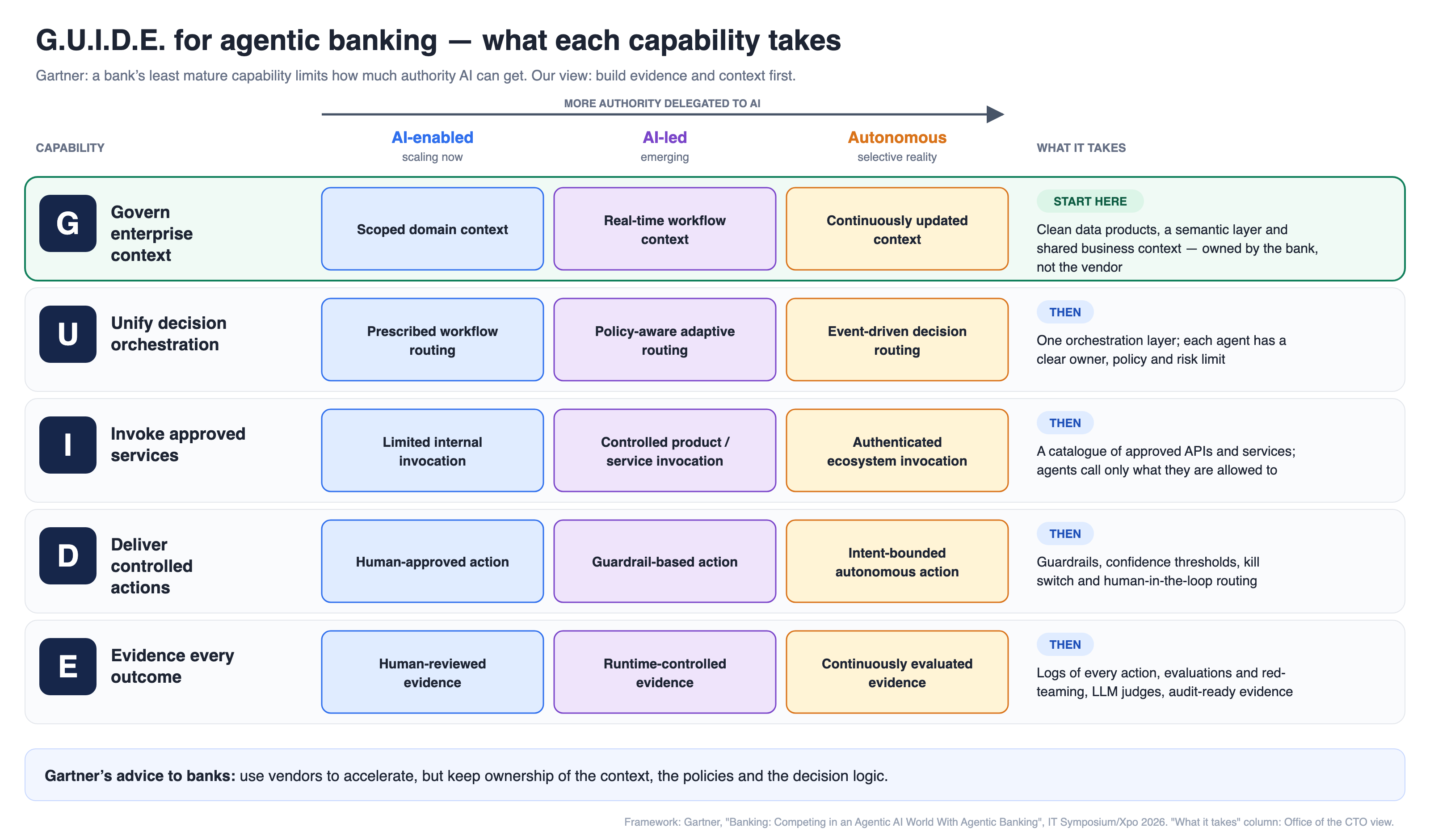
Agentic banking is a spectrum: AI-enabled (scaling now) → AI-led → autonomous
"Not about more AI — about where AI can act and under what control"
G.U.I.D.E.: Govern context · Unify orchestration · Invoke approved services · Deliver controlled actions · Evidence every outcome
Build vs. buy is now about who controls the intelligence — banks should keep context, policy and decision logic
Auto-loan agents at a European bank: 2 days → 15 minutes, cost per loan more than halved
Banking: agentic banking session
🧭How we can adopt it — our point of view
Gartner's message, read as a way of working. These are principles for us and for the clients we advise, not a product list.
Stop counting AI use cases. Pick fewer bets, prove them, govern them while they run, and make each one leave something the next one can reuse.
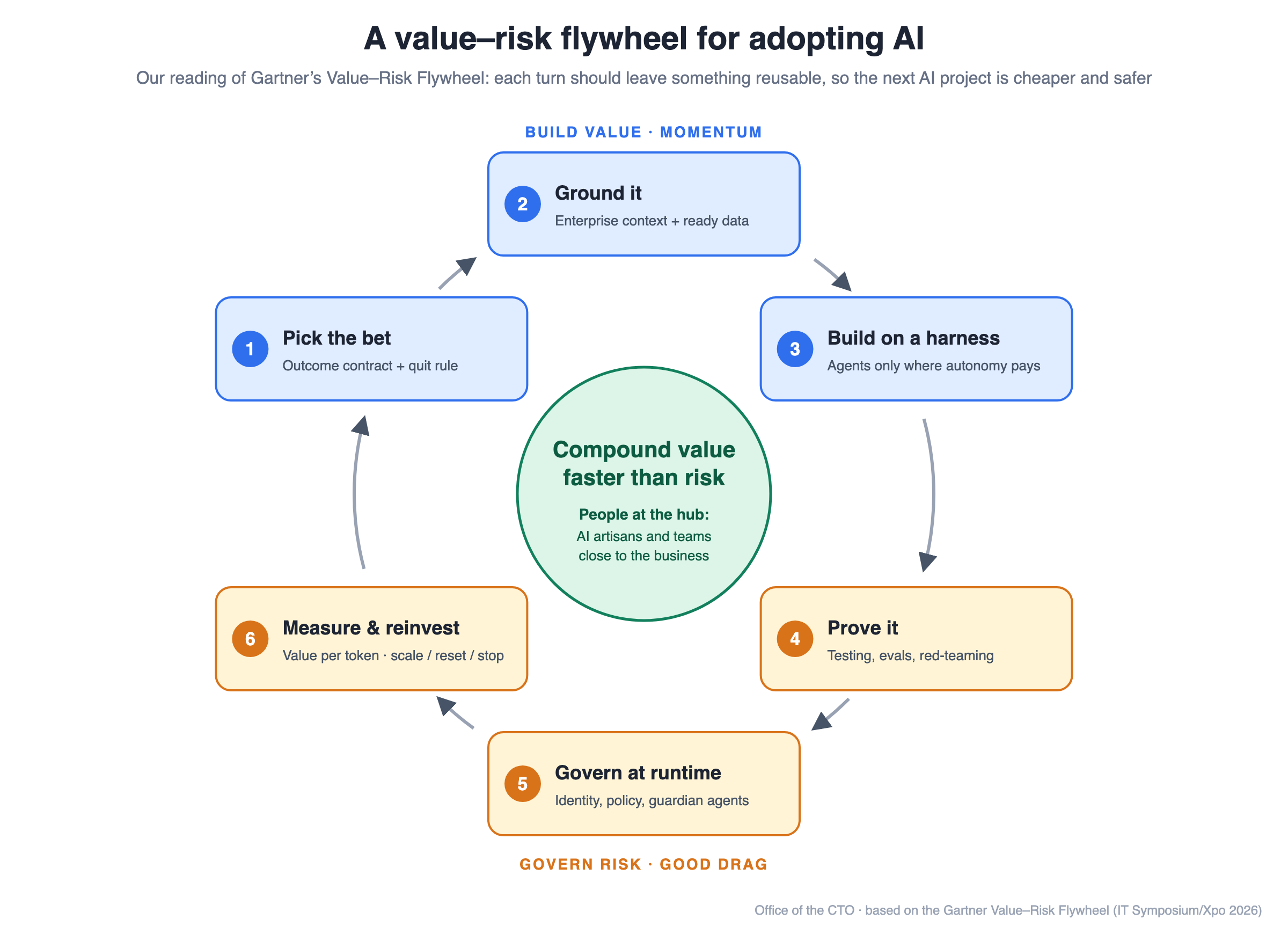
A value–risk flywheel for adopting AIThree steps build value, three steps govern risk; the hub is peopleOur reading of the Gartner Value–Risk Flywheel
What each step means
Pick the bet: write an outcome contract (baseline → goal → owner → when to stop) before funding
Ground it: get the data and business context ready first; context is the moat
Build on a harness: use agents only where autonomy pays; wrap models with context, memory and governance; expect many models, not one
Prove it: test, evaluate and red-team before scale — especially AI-generated code and agents
Govern at runtime: every agent has an identity, an owner, a policy and a kill switch
Measure & reinvest: track value per token and the total cost of AI; scale, reset or stop
Test for any AI initiative: which step does it strengthen, and what does it leave behind for the next one?
Our point of view
Gartner is right that volume is the trap — most AI portfolios are a list of pilots, not a system
Governance is not the brake; it is what lets you go faster safely ("good drag")
Context and evidence will decide who scales agents first — they are slow to build, so start now
Run costs, not build costs, will surprise people — plan with finance early
How we adopt it ourselves
Outcome contract and a stop rule for each internal AI initiative
Measure value per token on our own AI work
Managed democratization: sandbox, templates and registry for business-built agents
Redesign our delivery teams (see team model)
What we tell clients
Lead with: compounding value, value per token, outcome contracts, prove it before you scale
Avoid: "we delivered X use cases", "tokens are cheap", "AI writes half the code", "governance slows you down"
🏦Agentic banking — how to apply G.U.I.D.E.
Gartner: agentic banking is not about more AI, it is about where AI can act and under what control. A bank's weakest capability caps how much authority its agents get.
G.U.I.D.E. — what each capability takesFive capabilities across AI-enabled, AI-led and autonomous banking, with what it takes to build each oneFramework: Gartner · "What it takes": Office of the CTO view
Our point of view
Start with Evidence and Context: no regulator or risk team will grant agents authority without them
Begin in well-defined workflows (onboarding/KYC, payments processing, servicing); keep judgement-heavy lending under human control longer
Design for the enterprise — shared orchestration and evaluator agents — not one agent per use case
Buy for speed, but the bank should own its context, policies and decision logic
What it means for the banks we work with
CIBC: Callisto is a live servicing agent — a natural place to add evaluation; GPS payments sit in the first workflows banks will delegate
BNC: integration seams are where evidence and decision logic must stay with the bank
Manulife Bank: journeys no longer start in the bank's channels — discoverability matters
Enstream: identity and KYC feed onboarding, the first workflow to get agents
Framework terms: Gartner, "Banking: Competing in an Agentic AI World With Agentic Banking", IT Symposium/Xpo 2026.
🗺️Banking domain planning — how we decide
From our 2027–2028 banking focus work: own a clear position in two or three banking domains by end of 2028, in the US and Canada. Draft framework for discussion.
Gate
Question
What we check
Passes when
G1 — Right to win
Can we prove it today, not just pitch it?
References, people and case studies we already have; certifications (SOC 2, ISO 27001, ISO 42001); delivery presence
At least one reference and a named team — or a credible path within 6 months
G2 — Market pull
Is someone buying, now?
Who buys and how (direct or via vendor panel); budget and urgency; trigger events in the next 12–18 months (conversions, mergers, OSFI E-23 on 1 May 2027, vendors shipping agents)
A reachable buyer, a real budget and a dated trigger
G3 — Repeatability & economics
Will one win lead to the next?
Same pattern across banks and tiers; white space versus global SIs and core vendors; deal size; a platform partner path; US vs Canada differences
The second and third deal reuse most of the first
How we reach the verdict
Score each candidate (a domain or a system layer) 1–5 on G1, G2 and G3
Must pass all three gates; G1 can pass on a 6-month plan, G2 cannot be waived
Rank by total score; pick two or three
Each pick gets a role: Lead (invest and sell), Adjacency (sell when it comes with a lead), Skip
Re-score every quarter as triggers and references change
Domain play or system play?
Choose a domain (e.g. lending) when the buyer is a business-line owner, rules are domain-specific (adverse action, collections), and our references are domain stories
Choose a system layer (e.g. conversions, data, integration, AI agent assurance) when the same pain repeats across domains, the buyer is the CIO/CTO/CRO, and rules are horizontal (E-23, model risk)
Often both: lead with one layer, land it in one domain, then carry the layer to the next domain
Questions still to answer
Where do we already have references and people?
Who buys in each domain, and do we need a vendor panel first?
Which trigger events land in the next 12–18 months?
Where are big SIs entrenched, and where are the gaps?
What certifications, partners and US delivery do we lack?
👥Team model — from SDLC roles to two AI-era teams
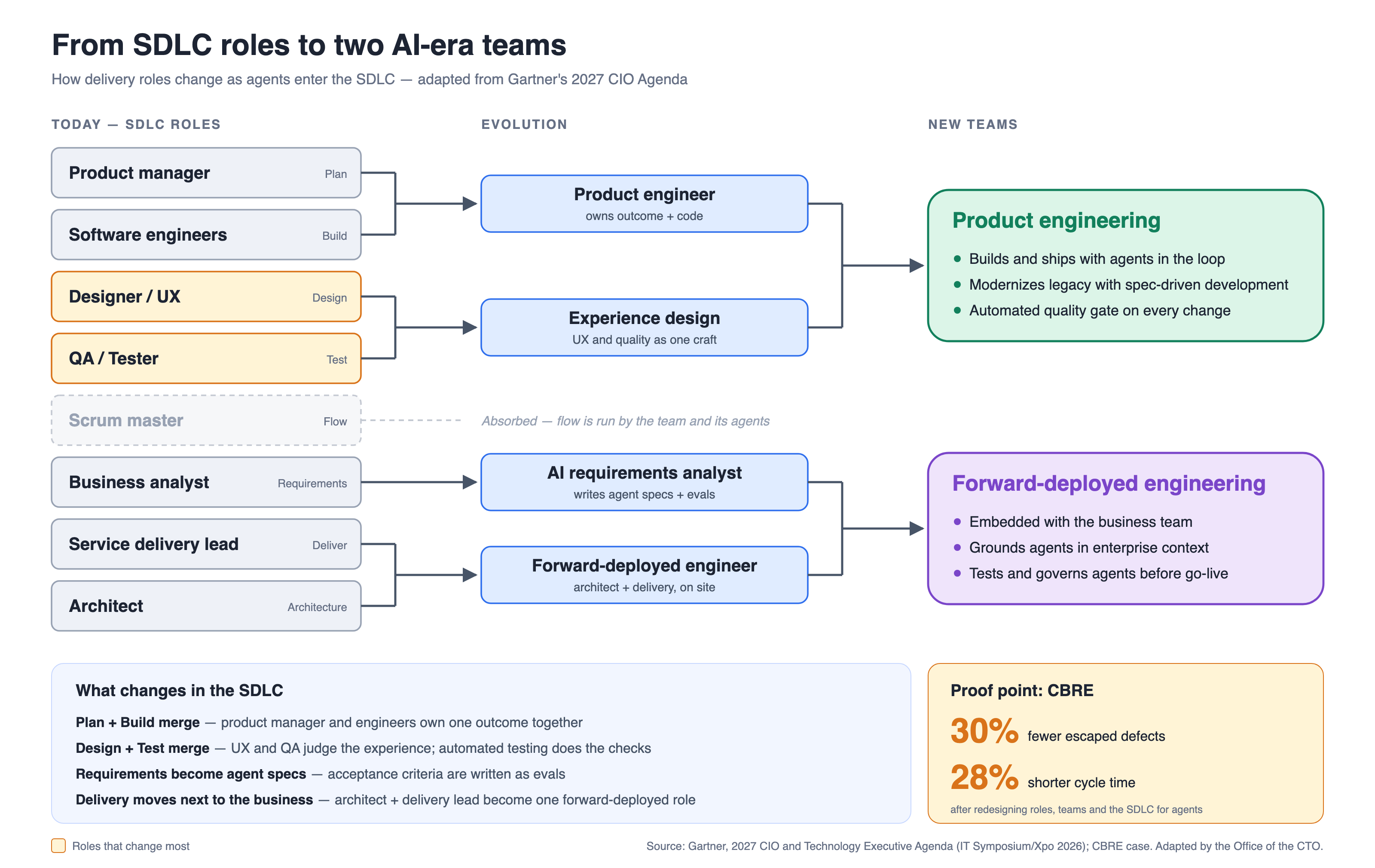
Gartner's view of how delivery roles change: product engineering builds and ships with agents in the loop; forward-deployed engineering sits with the business and makes agents safe to use.
Current roles → evolution → new teamsProduct manager + engineers become product engineers; design + QA become experience design; business analysts become AI requirements analysts; delivery lead + architect become forward-deployed engineersAdapted from Gartner's 2027 CIO Agenda · CBRE case
What changes in delivery
Plan + build merge — one team owns the outcome
Design + test merge — automated testing does the checks
Requirements become agent specs and evals
Delivery moves next to the business
How we adopt it
Try the shape on one or two of our own engagements first
Hire and grow to it: product engineers, AI requirements analysts, forward-deployed engineers
Reskill QA and BA roles early — Gartner expects most engineering and data roles to need it by 2030
🟡Manulife & BNC
Manulife — assessment
Scope now covers the mobile app and web
Size the micro-frontend opportunity and optimize the BFF layer
Second angle: one view of products and services on the web, easier to find — pre-sign-in and post-sign-in
SOW drafted in Manulife's template; risk mitigation plan (Exhibit C) complete
Micro Frontend Discussions 1 and 2 held with Arnold
Open: project manager to be named
Arnold Katebi · Shiv · Jigar · M. Siddiqui
National Bank of Canada (BNC)
Integration engagement under way with Pascal's team
Our role: managed-service integration between the new wealth-management product and BNC core systems (CRM, payments, others)
Needs integration architects with wealth-management knowledge
Resumes in from Vas; Tech Lead and Solution Architect interviews start Oct 29
Jigar is overall architect on the integration until then
Client wants all resources onshore — offshore requests being converted
Pascal (BNC) · Jigar · Imran · Vas · Naresh
🔵Rogers
New RFI — Digital Search & Agentic AI Discovery and Pilot
BPM007704, due Nov 6
Brief circulated Oct 21; RFI folder shared with the team
Bid / no-bid and lead still to confirm
M. Siddiqui · Shiv · Hamza · Hussain · Naresh
Test-case agent & performance
Test-case agent POC walkthrough requested by Adnan
Test-case management tool request still open
Rogers Performance Monitoring session; October performance document in progress